How Is “Made in Yiwu” Contributing to the World Cup?
How Is“Made in Yiwu”Contributing to the World Cup?
— An interview with Wu Xiaoming, President of the Yiwu Sports and Fitness Products Industry Association
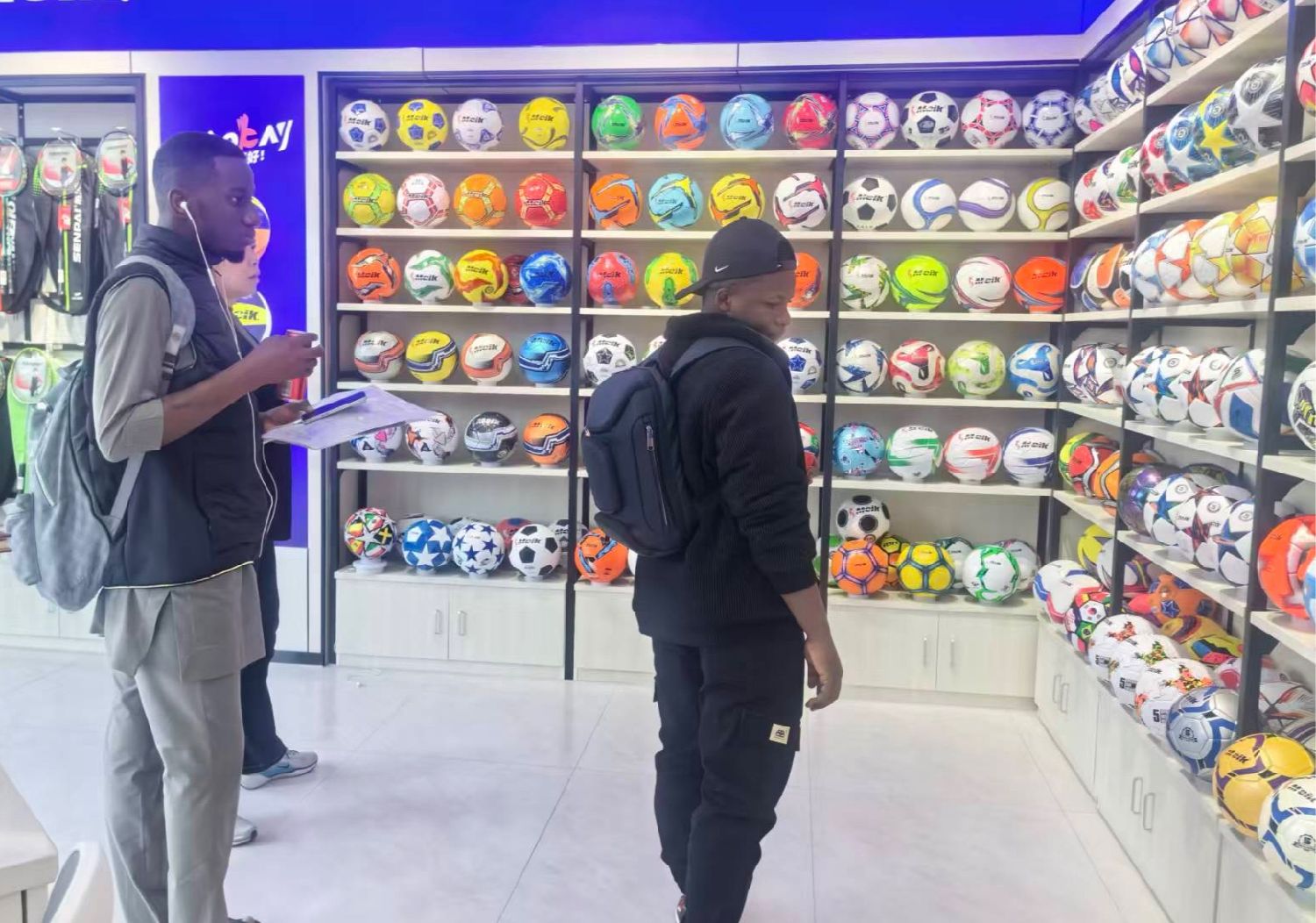
Foreign buyers examine soccer-themed products at Wu Xiaoming’s store. (CNS)
Even before the FIFA World Cup 2026 kicks off in the United States, Canada and Mexico, Yiwu—known as the “world capital of small commodities”—has already entered World Cup mode.
Demand for tournament-related merchandise has been booming, especially for creatively designed products. Replica FIFA World Cup trophies have even sold out through both online and offline channels.According to Yiwu Customs, exports of sporting goods and equipment from Yiwu reached 2.83 billion yuan (about US$394 million) in the first quarter of this year, up 12% year on year.
What are the highlights of “Made in Yiwu” for this World Cup? Why does Yiwu occupy such an important position in the global sports-event supply chain? And what does its transformation reveal about the upgrading of Chinese manufacturing?
Recently, Wu Xiaoming, President of the Yiwu Sports and Fitness Products Industry Association and Chairman of Yiwu Aokay Sports Goods Co., Ltd., shared his insights with China News Service.
CNS: How are exports of sporting goods from Yiwu performing ahead of the 2026 World Cup? What are the new highlights compared with the Qatar World Cup?
Wu Xiaoming:The tournament has expanded from 32 to 48 teams. Several teams, including Uzbekistan, Jordan, Curaçao and Cape Verde, have qualified for the finals for the first time, while Iraq has returned to the World Cup after a 40-year absence. These developments have significantly increased demand for related merchandise.
We have received football orders from some of these newly qualified markets. Although individual orders are not large, repeat orders continue to arrive.
Ahead of every World Cup, Yiwu businesses adjust their product lines and production plans according to market demand. This year, many companies have launched customized products for overseas buyers. For example, mini jerseys designed for children and pets have become popular among families watching matches at home.
Some manufacturers have also introduced upgraded versions of the“screaming chicken toy”—a cheering toy featuring a football and team jersey. Customers can customize the colors, patterns and jersey numbers. These creative products have been well received.
According to industry estimates, products made in Yiwu accounted for nearly 70% of the merchandise sold during the Qatar World Cup. While no official estimate is available yet for this tournament, many merchants report that the order cycle started earlier than in previous years.
Some companies began preparing inventory as early as last summer, and most shipments were completed before this year's Spring Festival. Current orders are largely repeat purchases, and the pace of reorders is accelerating as the tournament approaches.
CNS: What gives Yiwu its competitive advantage in the global sports-event supply chain?
Wu Xiaoming: As a major hub for international trade, Yiwu has accumulated extensive experience in foreign commerce and is often called the “world's supermarket.”
Its logistics network is one of its greatest strengths. Supported by integrated air, rail, road and sea transportation, as well as the China-Europe freight train service, logistics have become faster and more cost-effective, enhancing Yiwu's competitiveness in global markets.
At the same time, Yiwu benefits from a highly developed supply chain. Raw materials, components and packaging materials can all be sourced locally, reducing both production time and costs.
Unlike traditional large-scale manufacturing, Yiwu's economy is driven by small and medium-sized enterprises specializing in different products. Buyers can source footballs, jerseys, horns, flags and decorative items all in one place and ship them together, further lowering procurement costs.
Years of participation in major international sporting events have also helped Yiwu merchants develop a mature business model for the sports economy, while earning long-term customers and growing recognition worldwide.
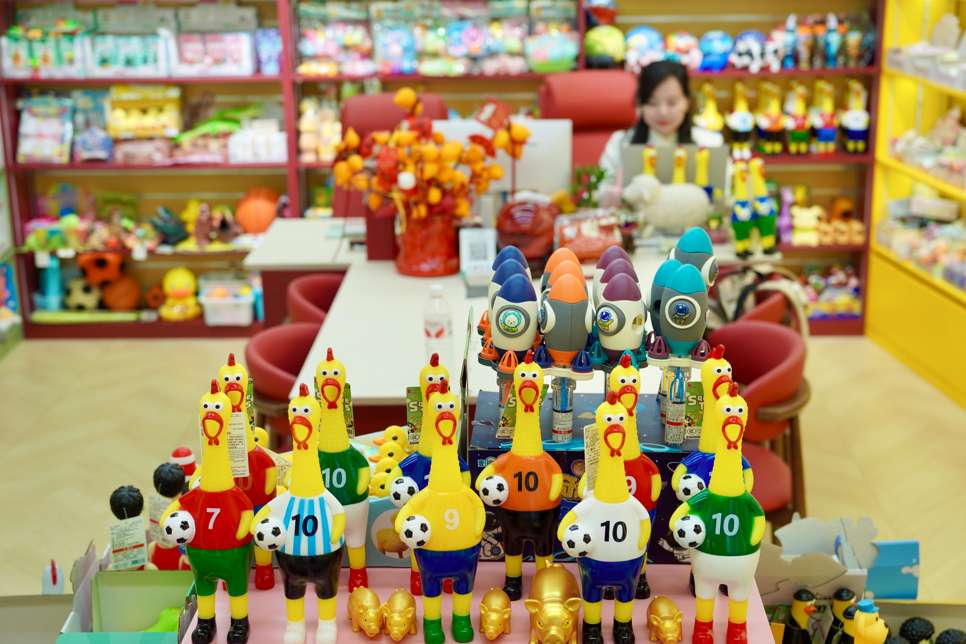
A Yiwu merchant displays a “screaming chicken” World Cup-themed product for the 2026 FIFA World Cup on April 21. (CNS)
CNS: In recent years, Yiwu's sporting goods industry has shifted from competing on price to competing on creativity and intellectual property. What drove this transformation, and what results has it achieved?
Wu Xiaoming: The transition has not been easy, but it was necessary.
In the past, Yiwu's small-commodity market relied heavily on low prices and high sales volumes. Entry barriers were low, and businesses often rushed into the market during major events such as the World Cup. That model was not sustainable.
Rather than making quick profits from one-off deals, companies increasingly want to build long-term businesses.
In recent years, the association has encouraged member companies to pursue high-quality development, strengthen brand building overseas and improve intellectual property protection. More businesses are moving from exporting products to exporting brands.
Merchants are investing more in original designs, applying for patents and trademarks in advance, and introducing officially licensed IP products to increase added value.
The association is also promoting standardized production for products such as footballs, pickleballs and dartboards, encouraging companies to establish their own product standards.
Footballs, for example, must meet strict requirements for materials, roundness, air retention, impact resistance and water resistance. Match-quality footballs require even higher standards.
Our company led the development of the group standard Competition Football for Adults. Several indicators exceed international standards. These higher standards have helped our products enter the premium market and gain broader recognition at home and abroad. Products meeting these standards were also selected as official commemorative merchandise for the Qatar World Cup.
Establishing standards enables companies to move beyond low-margin competition and enter higher-value markets, improving their ability to withstand market risks.
Today, "Made in Yiwu" is still undergoing a transition from labor-intensive manufacturing to technology-intensive production, while advancing digitalization, smart manufacturing and green development.
CNS: What does the transformation of “Made in Yiwu” reveal about the upgrading of Chinese manufacturing?
Wu Xiaoming: Over the years, Yiwu has continued to write a new chapter in the story of “small commodities, big market.” As an important window connecting China with the world, Yiwu trades with more than 230 countries and regions.
Through years of development, Yiwu manufacturers have actively combined “bringing in” and “going global” to fill market gaps. They have shifted from OEM production, low-cost competition and private-label manufacturing toward original design, licensed products and standard-setting.
This transformation reflects the broader upgrading of Chinese manufacturing as it moves up the global value chain from lower-end segments to higher-value activities.
China benefits from a vast domestic market, a complete industrial system and strong policy support. It is evolving from a passive participant in global value chains into a contributor to industry standards and rules. With continued development, Chinese manufacturing will increasingly become synonymous with high quality, advanced technology and greater value creation. (CNS)