The Last Operating “Qiaoxin Letter Writer” in Quanzhou: A Sheet of Paper Carrying Deep Affection Across Distance
One person, one desk, one pen—the wooden sign reading "Qiaoxin Letter Writing Service" has long since become weathered and worn. At 77 years old, Jiang Mingdian appears almost every day at the entrance of the Lianyi Shopping Mall parking lot on Renmin Road in Shishi, Quanzhou, Fujian Province. From around 9 a.m. until sunset, rain or shine, he continues his work of writing Qiaoxin on behalf of others—an occupation he has upheld for 59 years.
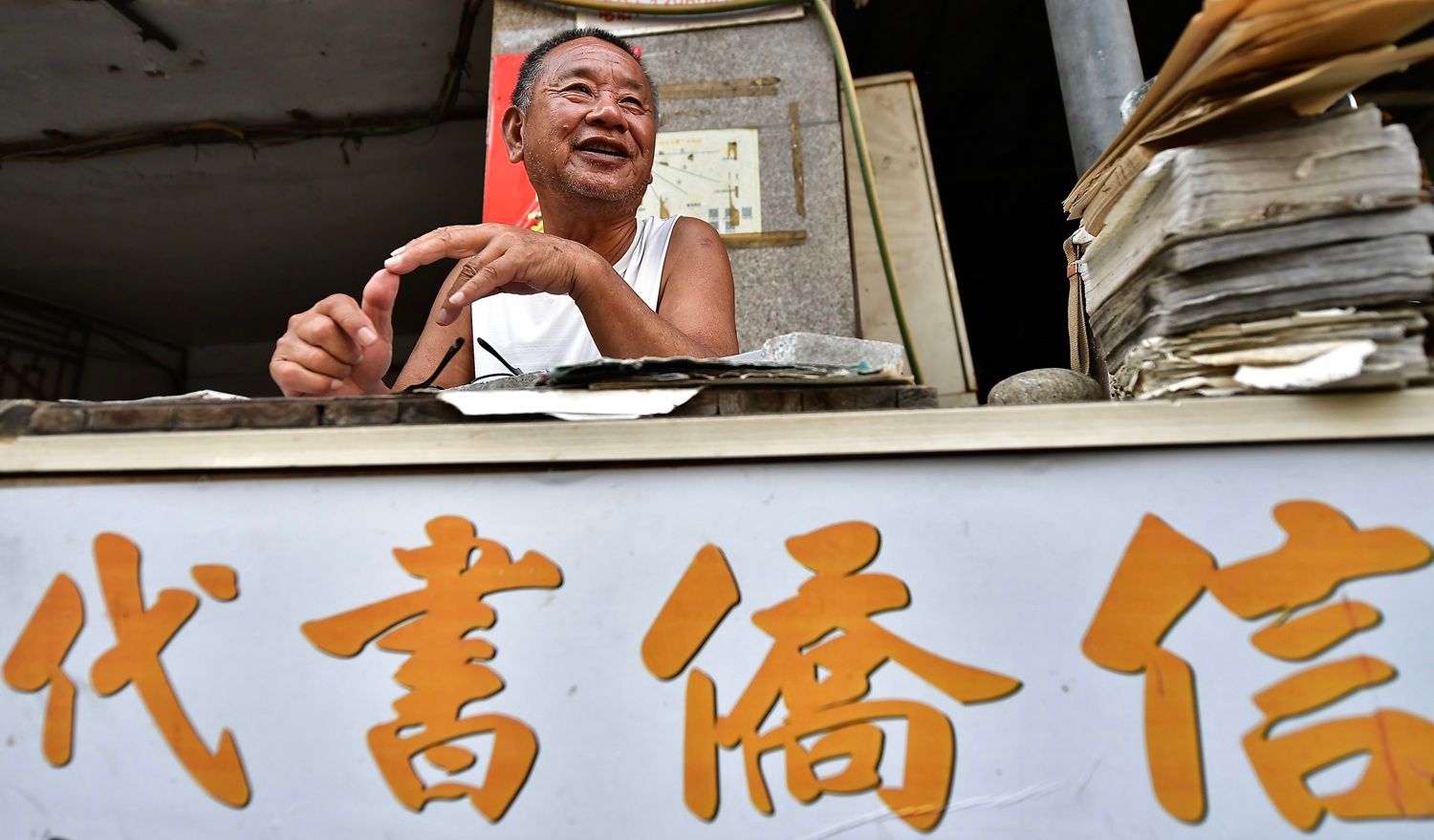
The last Qiaoxin letter writer Jiang Mingdian. (CNS)
Jiang says that just a few days ago, after watching the film Dear You, he felt "goosebumps all over his body," and "his mind was filled with memories of writing letters for 'Fanke Shen'(the homebound wives of overseas Chinese migrants) in the countryside before." On May 17, for the first time in his life, Jiang left Quanzhou to attend a promotional event for Dear You in Beijing.
As the last remaining active "Qiaoxin letter writer" in Quanzhou, Jiang has written more than 100,000 Qiaoxin in his lifetime. These letters carry the joys and sorrows of generations of overseas Chinese families.
"Among all the Qiaopi I have written in my life, most were for the 'returned overseas women,'" Jiang said. In the Minnan (southern Fujian) dialect, men who went to Southeast Asia to make a living were called "Fanke" (overseas Chinese migrants), while the wives who remained in their hometowns were called "Fanke Shen," which refers to the group represented by the character Ye Shurou in Dear You. "Shurou's husband went to Nanyang to make a living, but died in a foreign land, and the couple never saw each other again. Among the 'Fanke Shen' I have known, the proportion who never saw their husbands again is as high as 90 percent."
Jiang explained, "most of my clients had limited education and tended to repeat similar phrases in their letters. For decades, I have written the same kinds of words over and over again—missing them, waiting for them, hoping for reunion."
He recalled one woman whose husband had gone to Nanyang for many years. In her letters, she would repeatedly ask, "When will you come back?" and say things like, "Tell him everything is fine at home." Once, Jiang added an extra line for her: "youthful beauty fades against the green hills; in the blink of an eye, youth is gone; spring flowers and autumn moons pass by in vain." After reading it to her, she teared up and said, "Dian, you have spoken the words in my heart."
"I have been moved many times over the years of writing Qiaoxin, but most of the time I don't express it," Jiang said. He added that someone is currently compiling and organizing these stories long buried in memory, and a book about the life of these Qiaoxin letter writers is expected to be published this year.
After returning from Beijing, Jiang's business improved noticeably, as more tourists came after watching Dear You and sought him out. "I just helped a couple from Guangdong write a letter to their parents," he said. Many curious visitors want to learn about the history of Qiaopi, "and as long as they are willing to listen, I will slowly tell them when I have time."
"Many young people also come to me to write letters to their future selves," he said. Seeing more and more young people appreciating the history of the overseas Chinese homeland and traditional Chinese culture, Jiang feels gratified. He said, "I will stay at my small stall and be the bridge—words pass from this end, and longing is carried back from the other." (CNS)