Sinologist | From “Outside the Great Wall” to “Awakening”: A U.S. Sinologist on Modern Chinese Art
“Even with a pencil you can achieve lifelike effects, so why did Shi Lu insist on using the brush?” In a cross-cultural dialogue on art, American sinologist and art historian Martin Powers posed this question to Yang Xiaoyang, former president of the China National Academy of Painting.
The“A Shared Gaze, A Single Painting”event, hosted by the People’s Fine Arts Publishing House in Beijing, recently brought together Martin Powers, Yang Xiaoyang, and Yu Yang, vice dean of the Central Academy of Fine Arts, along with other scholars. They discussed works by modern and contemporary Chinese artists Shi Lu and Wu Guanzhong — including Shi Lu’s "Outside the Great Wall" and "As You Sow, So Shall You Reap", as well as Wu Guanzhong’s "Awakening", "Net", and "Wild Grass"— exploring how 20th-century Chinese art responded to Western realism and modernism while developing its own artistic path.
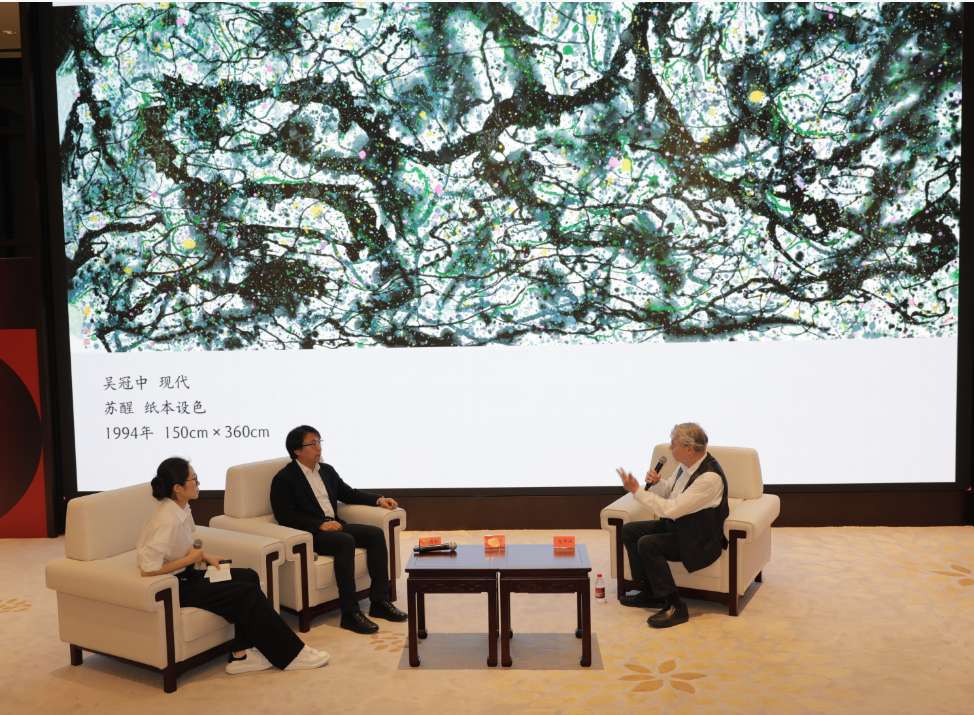
At the event. (Photo provided by the interviewee)
“Realism” Behind Tradition and Emotion
Discussing Shi Lu’s 1954 painting "Outside the Great Wall"(also known as "The Train Arrives"), Yang Xiaoyang described it as a classic example of socialist realism. The work depicts a train entering the foothills of the Qilian Mountains, where Tibetan herders watch it with excitement. The composition uses linear perspective and chiaroscuro-like modeling, with varied gestures among figures and sheep, creating a strong sense of immediacy.
Powers observed:“This painting is so realistic that the expressions of the people, the light and shadow on their clothing, even the individuality of each sheep are clearly conveyed. But this is not the monopoly of Western painting — these are precisely the qualities of Song Dynasty painting, where horses, dogs, and cattle all carry inner emotional states.”
Against the backdrop of its time, what does it mean that Shi Lu used a brush rather than a pencil to achieve such realism?
In Powers’ view, this reflects how 20th-century Chinese artists actively engaged with Western “scientific painting” methods such as perspective and anatomy. At the same time, he emphasized that the value of Shi Lu’s work lies not only in technical hybridity, but in the emotional concern for ordinary working people expressed in the painting.
Responding to Powers, Yang Xiaoyang further noted that within the social context of the time, Shi Lu’s commitment to depicting lived reality and serving the people was fundamental to his artistic philosophy. Coming from the Yan’an Lu Xun Academy of Fine Arts, he had long been devoted to ordinary people and public service. Yang added that the painting feels convincing precisely because of this lived background.
Powers agreed, saying:“This is not only a question of science — it is also a function of the human heart.”
Breaking Free from Binary Thinking
When the discussion turned to Wu Guanzhong’s 1994 ink work"Awakening", Powers offered a more conceptual interpretation. The painting uses bold, expressive ink lines and dots to depict the twisting forms of ancient cypress trees, with a strong abstract quality. However, Powers argued that its significance lies not only in formal innovation, but in Wu’s ability to escape a historical intellectual trap.
He noted that from the mid-20th century onward, art worldwide became highly politicized. “During the Cold War in the United States, Abstract Expressionism was regarded as a symbol of ‘freedom,’” Powers explained. This opposition was rooted in a Hegelian binary framework: abstraction vs. figuration, modern vs. traditional, West vs. China. “Many Chinese intellectuals also accepted this framework. Once you accept it, you become trapped within it.”
In his view, Wu Guanzhong’s greatness lies precisely in rejecting this either-or logic.
“He refused the zero-sum opposition between figuration and abstraction, and believed that form and content are dialectically related.”
Powers argued that Wu’s ability to transcend this came from his deep understanding of traditional Chinese painting. Using Wu’s brushwork as an example, he pointed out that while Western abstract expressionists such as Jackson Pollock poured paint onto canvas in pursuit of pure abstraction and chance, Wu used the brush on xuan paper to create similarly dynamic effects — yet never abandoned recognizable imagery, such as distant mountains, fish in water, or textures of land.
“Wu Guanzhong is far more complex than Pollock,” Powers said. In his paintings, the “real” consists of visible forms, while the “void” is left to the viewer’s imagination. More subtly, Wu sometimes juxtaposed two completely different visual languages — highly skilled, expressive brushwork alongside seemingly naïve forms. “This coexistence of refinement and simplicity already appeared in Northern Song literati painting; in the West, it only emerged in the late 19th and early 20th centuries.”
The Tradition of “Playful Creation” and Another Modern Path
Powers also pointed out an often-overlooked intellectual connection. He noted that early 20th-century British art critic Roger Fry, after reading translations of Guo Ruoxu’s "Experiences in Painting", realized that a single ink line could convey an artist’s inner emotion — a realization that later contributed to Western abstract expressionism.
“Expressionist brushwork became an important element of modern Western abstract art, and this element came from Guo Ruoxu,” Powers said. In his view, historical reality does not fit neatly into the binary framework constructed in Western discourse.
He also drew on the Song Dynasty concept of xi zuo(“playful painting”) to describe Wu Guanzhong’s approach. “‘Xi zuo’ means I do not accept existing conventions of painting; I want to change them, even deliberately stylize or abstract them. In Europe, this only appears in modern times,” he said.
Yu Yang responded that viewing Chinese art through the lens of Western sinology often reveals traditional lineages overlooked by domestic scholarship. “Wu Guanzhong required a kind of ‘patricidal impulse’ — a rebellion against tradition in order to grow. But very few people can both break and rebuild successfully as he did.”
At the end of the dialogue, Powers concluded:“So these oppositions — I think we should loosen them a little, make them more flexible.”(W.E. Talk App)