Why Is the Century-Old Zhongshan Suit Experiencing a "Cultural Trend" Revival?
A few months ago in Los Angeles, well-known influencer Hassan Abi appeared on the red carpet of The Streamer Awards wearing a Zhongshan suit custom-made in China.
After a century of evolution, the Zhongshan suit is returning to the public eye in an unprecedented way.
Chen Fuxing, a representative inheritor of the intangible cultural heritage of Zhongshan suit tailoring techniques and general manager of "Zhongshan Chinese Suit", noted that the Zhongshan suit is a model of cultural integration between East and West in fashion. It incorporates Western tailoring techniques such as structured three-dimensional cutting and structured silhouettes, while preserving the symmetrical aesthetics, ritual significance, and understated elegance of traditional Chinese clothing. It is a garment that combines practicality with cultural meaning.
Under normal circumstances, a bespoke Zhongshan suit takes at least two weeks to complete. "We must first understand the client's needs and wearing habits, as well as the occasions for which the suit will be used. From initial processing to embroidery and pattern refinement, and then multiple rounds of fitting adjustments, only then can the final piece be completed," Chen said.
In recent years, an increasing number of overseas Chinese have made special trips back to China to customize traditional garments such as the Zhongshan suit during visits home. "Dignified, appropriate, and elegant—it gives the wearer a strong sense of spirit, vigor and vitality." This is the common evaluation among them. Behind this also lies a sense of closeness to Chinese culture.
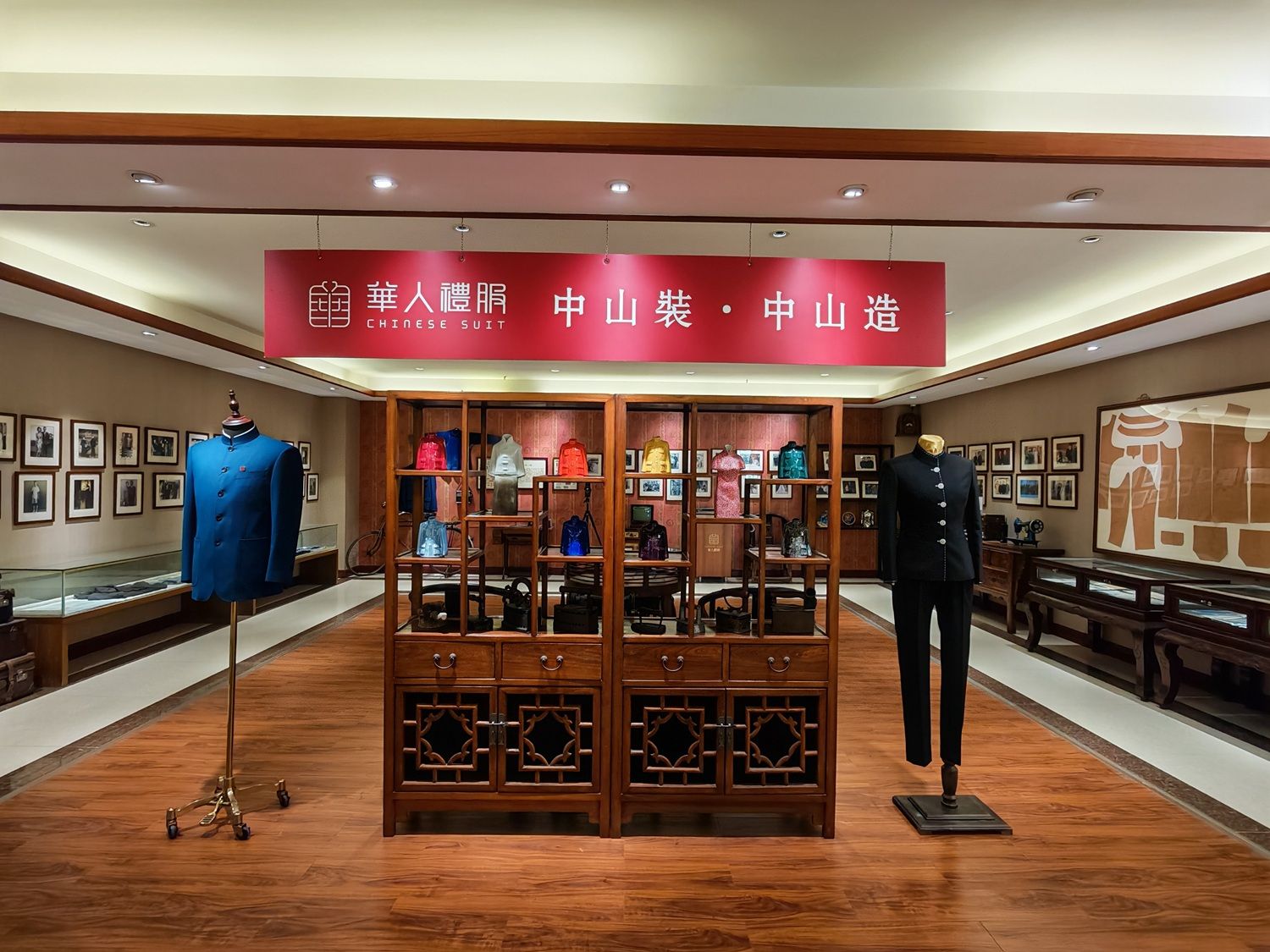
On April 18th, in Zhongshan, Guangdong Province, new styles of Zhongshan suits were on display. (CNS)
Today, leveraging the complete garment industry chain in Shaxi, Zhongshan, Guangdong, bespoke tailoring accounts for more than 35% of Chen Fuxing's company's customization business. His clients include dignitaries, scholars, and celebrities from SEA, Europe, America, Africa, Japan, as well as Hong Kong, Macao, and Taiwan.
"In years of cultural exchange abroad, we found that many foreign friends only recognize the outward appearance of the Zhongshan suit, but do not understand its cultural meaning. Therefore, we visited authoritative research institutions such as Sun Yat-sen Institute, worked with experts to verify historical records, and systematically organized the design philosophy, cultural connotations, and historical origins of the Zhongshan suit. Based on this, we compiled bilingual Chinese-English explanatory materials on its cultural significance," Chen said. This explanation breaks down language and cultural barriers, allowing foreign audiences to truly understand the Zhongshan suit, while also helping many Chinese realize that this garment carries such profound intellectual and moral significance.
"Cultural understanding is a gradual process. Even if one cannot immediately grasp all its historical depth, people can still feel the calm and dignified essence of Chinese aesthetics through its form and structure," Chen noted. He hopes that the Zhongshan suit can serve as a medium to convey an image of China that is inclusive, confident, humble, and profound to the world.
Today, as a "Chinese calling card," the Zhongshan suit frequently appears at international platforms such as the Boao Forum for Asia, the Olympic Games, the Education Forum for Asia, as well as "China Culture Year" in Italy and Russia. Chen Fuxing reflected that the Zhongshan suit allows people of different skin colors, the moment they wear it, to experience a calm yet firm Chinese temperament.
How to make a century-old design "break boundaries" among Gen-Z has become the question Chen Fuxing has pondered most in recent years. "In the past, young people felt that the Zhongshan suit was too 'serious' and belonged exclusively to their grandfathers' generation." To break this stereotype, Chen collaborated with the organizers of the National Style Chinese Tunic Suit Design Competition, the Sun Yat-sen Memorial Hall, transforming award-winning competition designs into finished garments through meticulous craftsmanship, stitch by stitch. Through exchanges and creative collisions with the new generation of designers, designers of "Zhongshan Chinese Suit" have gained extensive inspiration and fresh insights.
Today, Zhongshan suit customization has also evolved from simply pursuing "good fit" to becoming a form of "self-expression." Chen has noticed that more and more clients are no longer satisfied with traditional black and gray tones, instead requesting the incorporation of personal totems or family emblems into the fabric designs.
"In my view, the spiritual core of the Zhongshan suit's intangible cultural heritage craftsmanship that must never be lost lies in the artisan spirit of preserving traditional techniques and the cultural character deeply rooted in the garment itself. The values of integrity, humility, and devotion to family and country embodied by the Zhongshan suit are its true soul," Chen emphasized. (CNS)