Korean Sinologist Lee Kyu-gap: In the Age of AI, We Need People Who Truly Understand Chinese Characters Even More
"If I had to summarize my relationship with Chinese characters in one word, it would be—history." On the occasion of the United Nations Chinese Language Day on April 20th, Lee Kyu-gap, emeritus professor at Yonsei University, chairman of the Research Institute of Tripitaka Koreana (RITK), and a renowned sinologist, reflected on his academic life.
Driven by questions about history, Lee entered the world of Chinese characters. For more than half a century, he has collated variant characters and reconstructed fragments of stone classics. In tracing the remnants of written forms, he has forged a path of cross-regional civilizational dialogue.
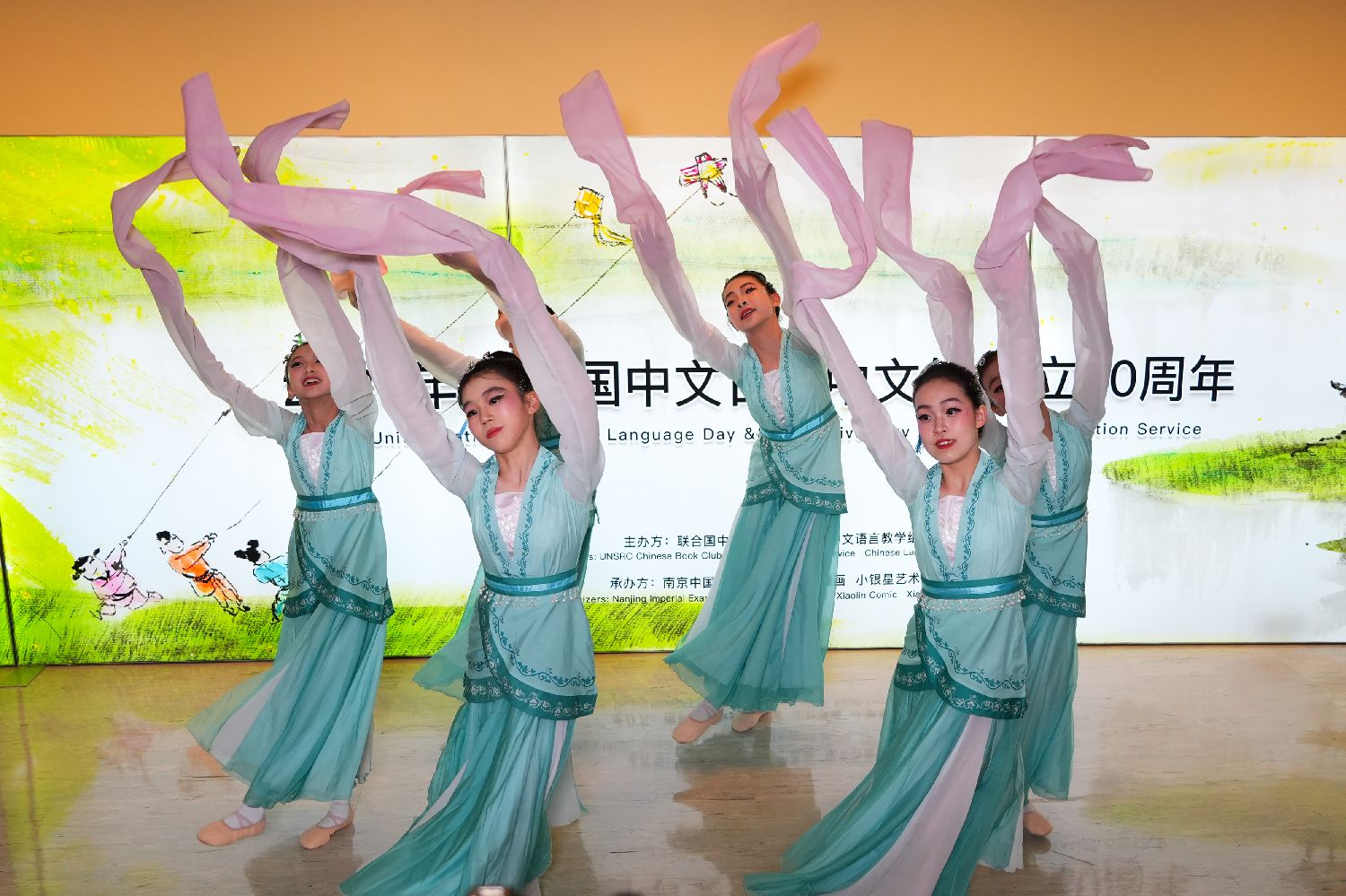
On April 20th, the 2026 UN Chinese Language Day and the 80th anniversary celebration of the establishment of the Chinese Translation Service were held at the United Nations headquarters in New York. (CNS)
Language is the most fundamental way to understand China
In Lee's view, the significance of learning Chinese today has not fundamentally changed.
Advances in transportation have brought the world closer, yet the prerequisite for genuine human connection remains language. "If you want to communicate with people from other regions, learning their language is always the most basic and most important way."
He believes that the core motivation for young Koreans learning Chinese today is essentially the same as in his own time: to understand neighboring countries and build communication skills.
What has changed is the environment. Recalling his student days, Lee noted that there were no electronic dictionaries, no online resources, and very few opportunities to communicate face-to-face with Chinese people. "You could learn Chinese, but had little chance to use it."
Today, things are entirely different: "As long as one has the will, everything is possible." He believes contemporary young people are living in the best era for learning Chinese.
Likewise, he emphasizes that for Chinese people, "learning Korean is equally necessary to deepen exchanges with Korea". In his eyes, language has never been a one-way tool of expression, but a bridge for two-way communication.
From obstacles in reading history to entering the world of Chinese characters
Lee's encounter with Chinese characters began with confusion in his historical studies.
In high school, he was deeply immersed in researching Korean history. At one point, intrigued by a particular historical period, he began consulting Korean-language materials. Soon, however, he hit a bottleneck—the key documents were all written in Chinese characters.
"To obtain more accurate historical materials, I had to master Chinese characters; otherwise, I would have had to give up." This experience changed the course of his academic path.
At university, he chose to major in Chinese to study Chinese characters. In graduate school, he further specialized in Chinese grammatology.
"Later I realized that to study Chinese characters, one must study history—and to study history, one cannot do without Chinese characters." From then on, language and history became inseparably intertwined in his academic world.
In his early academic training, Lee relied on traditional methods such as marking Judou(sentence breaks and pauses) to read classical texts. "All ancient Chinese historical materials are written in classical Chinese; apart from repeated reading, there is no other way." Reflecting on that time, he remarked, "It is an extremely tedious path."
Yet it was precisely this rigorous training that enabled him to independently interpret ancient texts. He firmly believes that true scholarship cannot rely solely on translations. "Translations are secondary materials. If you depend only on them, it is difficult to produce research that surpasses previous scholars."
"Since ancient times, there has been the saying that, 'There is no easy path in scholarship,' and I find that very true," Lee said.
Decades of "Wrestling" with Variant Characters
Lee has long focused on the origins and evolution of Chinese characters, particularly in the fields of oracle bone and bronze inscriptions. An unexpected collaboration once led him to shift his research direction again.
In 1993, he began participating in the digitalization of the Tripitaka Koreana. The team soon encountered a practical problem: many characters in ancient texts—especially variant forms—did not exist in computer fonts and had to be converted into standard forms for input.
What was initially expected to be a small task turned out to involve an enormous number and variety of variant characters. Lee spent several years cataloging them one by one, eventually compiling and publishing A Dictionary of Variant Characters in the Tripitaka Koreana.
"In all the ancient texts I have seen, none are written solely with standard characters; all are mixed with a large number of variant forms," Lee Kyu-gap explained the significance of studying variant characters. "A considerable portion of these variant characters is no longer in use. Without organizing them, accurate interpretation would be impossible."
From then on, he shifted his research focus to variant characters, systematically collecting and studying them across a wide range of texts. After years of accumulation, his work was compiled into Research on Variant Chinese Characters, published in 2022.
Some Chinese Characters "Reborn" in Korea
Lee also pays close attention to the "reborn" and evolution of some Chinese characters in Korea.
"Some Chinese characters in Korean no longer carry exactly the same meanings as in Chinese," he explained. For example, "gongfu(工夫)" in Chinese can mean time or leisure, but in Korean it has come to mean study or learning; "airen(爱人)" in Chinese often refers to a spouse, while in Korean it refers to a romantic partner.
"These changes reflect the vitality of language and writing," Lee said. Such semantic divergence is a natural result of linguistic evolution. Temporally, language and script experience semantic drift over time; spatially, they adapt to new environments and are redefined by the conventions of the local communities they reach.
The influence of Chinese on Korean extends beyond vocabulary to syntax. "Sometimes, listing only the Chinese-character words is enough for people to understand an entire Korean sentence," he said. For instance, the phrase "Daehan Minguk Government Establishment Commemorative Academic Conference(大韩民国政府成立纪念学术大会)" can be understood even without particles or other grammatical elements.
With his cross-cultural academic perspective, Lee Kyu-gap has observed differences between Chinese and Korean scholarly approaches, yet he believes these differences are precisely what create a complementary relationship. Chinese scholars tend to focus on the role of Chinese characters within China's own history, while overseas scholars often pay more attention to how these characters have influenced their own cultural traditions. "This is natural and valuable," he said.
He further pointed out that some Chinese characters used outside China do not exist in mainland usage, and even the same character may differ in pronunciation and meaning.
Thus, research from different regional perspectives can complement one another. "For example, the pronunciations of Chinese characters preserved in neighboring countries provide important references for studying ancient Chinese phonology."
"This kind of cross-regional complementarity and mutual verification is precisely the charm of the Chinese character cultural sphere," Lee said.
In the AI era, why still study languages intensively?
In the era of AI, translation tools are rapidly advancing, allowing people who do not share a language to achieve basic communication. Is deep language learning still necessary?
Lee Kyu-gap's answer is unequivocal: "AI translation ultimately relies on data provided by humans." He explained, "without manually annotated and translated training data, even the most powerful AI cannot function."
He has also noticed changes brought by the widespread use of input methods. "In the past, everything was handwritten; now almost everything is typed. Sometimes people can't even recall how to write simple characters." In his view, this shift does affect one's understanding of Chinese characters.
As for new stylized or unconventional character forms emerging in the internet environment, he considers them closer to a kind of "wordplay." "These forms function more like symbolic signs in certain contexts. They have not developed into standardized conventions and are fundamentally different from standard Chinese characters."
Looking back at the evolution of Chinese characters, Lee compares them to an "organic life form." "Chinese characters are now in a highly mature stage. Newly created characters still follow traditional formation principles. Even if some fine adjustments occur in the future, large-scale changes are unlikely."
Reconstructing stone classics: reviving civilizational dialogue
After retiring from Yonsei University in 2023, Lee has not slowed down; instead, his research has entered a new phase.
He is currently leading a project to reconstruct the stone sutras of Hwaeomsa Temple in Korea, dating back 1,300 years. This work is not only crucial to the history of Korean Buddhist texts, but also closely tied to the transmission of Chinese character culture in East Asia.
His ambitions go further. In the future, he hopes to systematically collate and compare the Tripitaka Koreana with Dunhuang manuscripts from China, creating a framework for direct textual comparison.
"If this can be achieved, I sincerely hope it will be a joint effort by scholars from China and Korea," Lee said.
After more than half a century of scholarship, this aspiration itself has become a powerful testament to how Chinese characters transcend borders and connect civilizations. (CNS)