Print Still Leads: Survey Finds Nearly Half of Chinese Adults Prefer Physical Books
On April 20, the Fifth National Conference on Reading opened in Nanchang, Jiangxi Province. At the event, the results of the 23rd National Reading Survey were released, showing that in 2025, nearly half of Chinese adults indicated a preference for“reading a printed book,” ranking first among all reading formats.
On April 20, in Nanchang, the results of the 23rd National Reading Survey were released at the Fifth National Conference on Reading. (Source: CNS)
Since 1999, the National Reading Survey, organized and conducted by the China Academy of Press and Publication, has been carried out 22 times. The 23rd survey was launched in August 2025, with samples collected from 195 cities across China, covering 31 provinces, autonomous regions, and municipalities. A total of 545,000 valid responses were obtained.
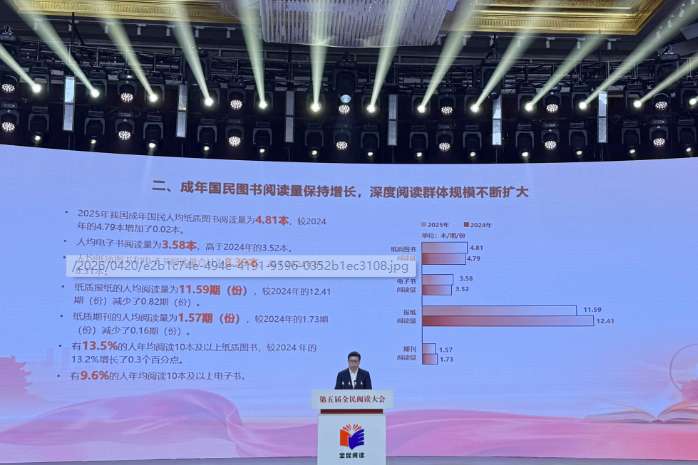
The findings indicate that the volume of book reading among Chinese adults has continued to grow, and the population engaged in in-depth reading has been steadily expanding. In terms of reading volume across different types of publications, the average number of printed books read per adult in China reached 4.81 in 2025. The proportion of adults who read 10 or more printed books annually was 13.5%, while 9.6% read 10 or more e-books per year.
Regarding reading formats, mobile reading and audiobooks are the primary forms of digital reading among Chinese adults, with the mobile reading rate remaining consistently high. In 2025, the mobile reading rate among Chinese adults reached 79%. An increasing number of people are choosing to read through audiobooks and video-based book summaries, with the proportions rising from 38.5% and 5.7% in 2024 to 38.7% and 6.3% in 2025, respectively.
In terms of preferred reading formats, 45.9% of Chinese adults in 2025 indicated a preference for“reading a printed book,” the highest among all formats. The data suggest that while digital reading has become more widespread, the value of print reading continues to be widely recognized.
This survey also added an assessment of minors’use of AI-assisted reading. The results show that approximately half of children aged 9–13 (49.3%) and adolescents aged 14–17 (53.1%) believe that AI tools are helpful in providing personalized recommendations. (Source: CNS)