From “Handcraft” to Cross-Industry Integration: The Millennia-Old Xiabu Embraces New Life
With warp and weft interlacing and looms creaking, in an old weaving workshop in Panlong Town, Rongchang District of Chongqing, Li Jiankang, now in his sixties, sits upright at his loom. With deft fingers, he twists ramie yarn, threading, denting, and beating the weft in smooth, flowing motions.
Having begun learning at the age of six and mastering the full process by fourteen, Li, a Chinese national-level representative inheritor of Xiabu weaving, has stayed devoted to this loom for more than fifty years.
As one of the traditional Han Chinese textile crafts, Xiabu weaving can be traced back to the late Eastern Jin Dynasty. Using ramie as its raw material, the production process is intricate and meticulous. Known for its breathability and suitability for summer wear, the fabric gets its name “Xiabu” (summer cloth). Xiabu from Rongchang was already being exported during the Qing Dynasty to regions such as Korea, Japan, and Southeast Asia.
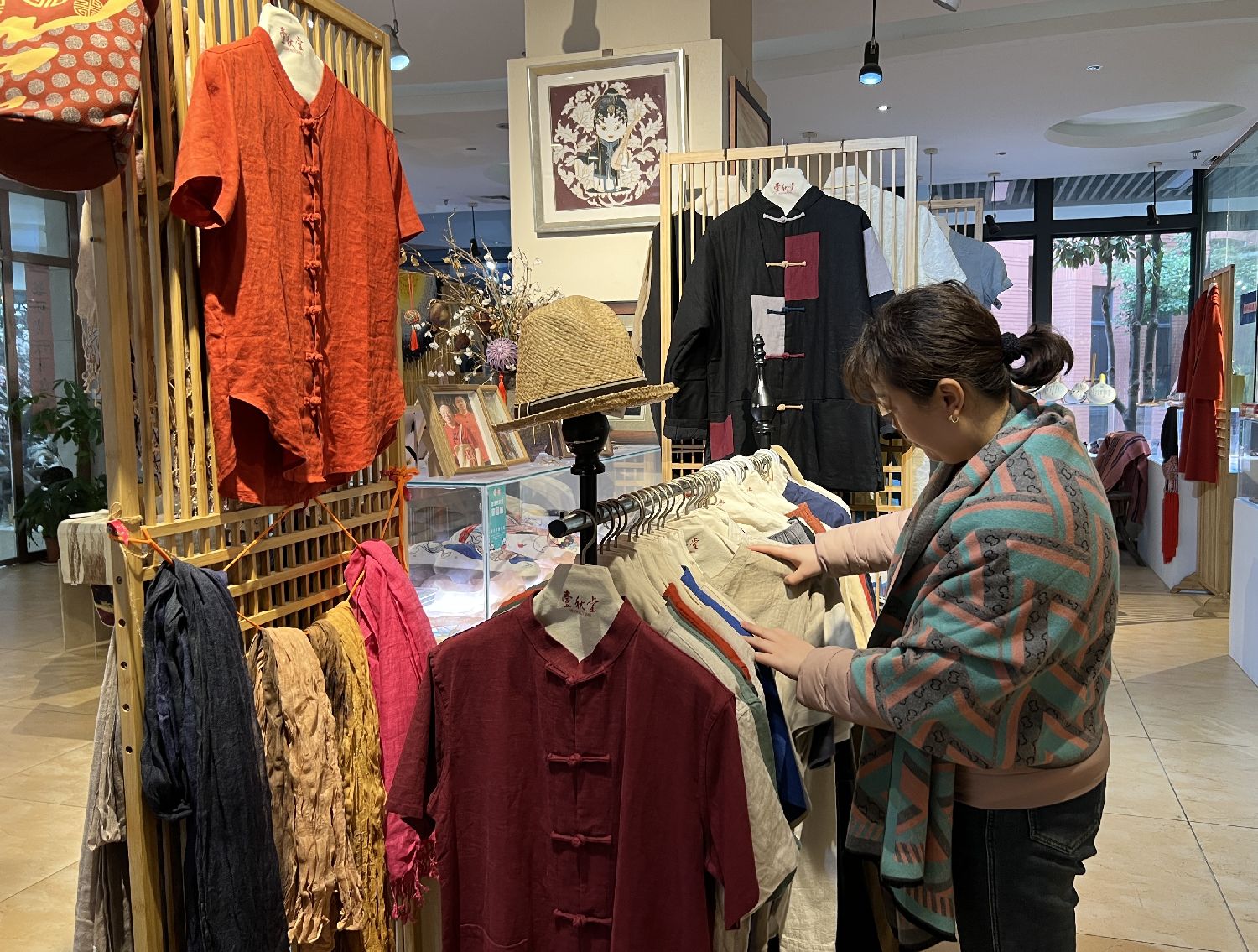
On February 5th, customers were choosing Xiabu products at the "Yiqiutang". (CNS)
Li explains that ramie, also known as the “Chinese grass,” is sown in spring and harvested three times a year. What is little known is that ramie harvested at different times produces fabrics of varying quality. “The best ramie comes in the height of summer, in July, when sunlight is abundant, resulting in fibers that are especially white and lustrous.”
“Xiabu is entirely handcrafted,” Li says. Although the production appears to consist of three main stages—ramie processing, yarn spinning, and weaving—it actually involves nearly a hundred procedures. From beating the ramie with bamboo poles, every step relies on manual skill. To produce a piece of Xiabu cloth that is “as thin as Xuan paper, as smooth as a mirror, as fine as silk gauze, and as light as a cicada's wing” requires not only perseverance, meticulousness, and patience, but also coordinated teamwork. There is no room for haste or carelessness.
However, due to long production times, low returns, and a shortage of inheritors, “how to keep Xiabu alive” once became a pressing challenge. In 2008, Xiabu weaving was inscribed on the second batch of National List of Intangible Cultural Heritage of China, gradually ushering in a revival.
“This is a 'Xiabu ancient brick-and-tile rubbing painting,' symbolizing the blessing of 'adding bricks and tiles' (contributing to prosperity),” explains Qi Tao, a district-level representative inheritor and founder of the brand “Yiqiutang,” to visitors at a Xiabu intangible cultural heritage workshop in the Chongqing Industrial Museum. The cultural and creative product blends Xiabu with traditional brick rubbing techniques.
Qi Tao has been engaged in the preservation and promotion of ramie weaving for over twenty years. In her view, safeguarding intangible cultural heritage does not mean locking traditional crafts in museums, but integrating them into modern life. To make ramie products aesthetically appealing, practical, and meaningful, her team focuses on cross-disciplinary innovation under the concept of “ramie + design,” developing more than a thousand varieties, including Xiabu fans, paintings, bags, clothing, accessories, sachets, and cushions.
Since 2018, Qi has established “intangible heritage workshops” in multiple regions, promoting Xiabu weaving in provinces such as Sichuan and Guangxi. Today, she and her team are accelerating efforts to build a Xiabu “intangible heritage ecosystem,” with plans to further integrate the craft with tea culture, architectural culture, and even cutting-edge technologies.
Official data show that Rongchang, known as the “Hometown of Xiabu in China,” is home to 62 representative inheritors of intangible cultural heritage at various levels. The local government has been committed to developing the “Hometown of China's Xiabu,” a comprehensive tourism destination integrating research and development, processing, trading, exhibition, sales, and experiential activities related to Xiabu. In 2025, it received nearly 7 million visitors, with total tourist spending reaching 3.896 billion yuan, both more than doubling year on year.
In this Town, one can often see Yan Xianying, a municipal-level representative inheritor and the 29th-generation descendant of the Yan family of Xiabu, busily at work. She actively promotes and popularizes the craft, having helped more than 10,000 people acquire the skill. “Each trainee is a seed of inheritance,” she says. “When more people understand and fall in love with Xiabu, it will go even further.”