Spring Break Meets Qingming, Boosting Spring Tourism Across China
This year, the concept of a “spring and autumn school break” was written into China’s 2026 Government Work Report for the first time. The report proposes supporting qualified regions in introducing spring and autumn breaks for primary and secondary schools, alongside implementing staggered paid leave for employees. So far, provinces including Jiangsu, Sichuan, Anhui, Hubei, and Hunan have announced spring breaks aligned with the Qingming Festival, creating a six-day holiday—dubbed by Chinese netizens as “the most family- and kid-oriented” holiday.
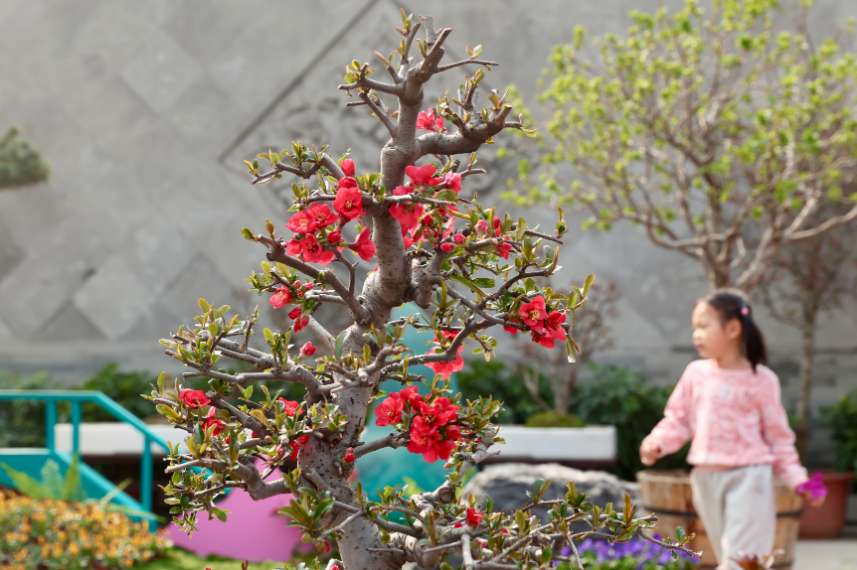
Children view crabapple bonsai at Taoranting Park in Beijing, March 26. Source: China News Service
At its core, the spring break reflects an evolution in educational philosophy: encouraging children to step out of the classroom, engage with nature, and connect with cultural heritage, broadening their horizons through real-world experiences. The six-day holiday fits well with family-oriented study tours, quickly becoming a top choice for China’s domestic travel and driving a surge in demand.
Data from major online travel platforms show that, boosted by the spring break extension, the upcoming Qingming Festival is expected to become a “mini Golden Week.” As of March 23, search and booking volumes for flights, hotels, homestays, and attractions from April 1 to 6 have nearly doubled year-on-year. Family travel stands out during this year’s Qingming holiday, with outdoor activities, flower viewing, and parent-child trips dominating. The number of passengers under 18 is projected to more than double, while youth visits to scenic spots may increase by over threefold.
At the same time, many regions have rolled out “spring break tourism packages,” offering incentives such as free admission to attractions, free transport, and discounted study tours to attract visitors and boost local consumption. In some cases, accompanying parents also enjoy free or discounted entry.
For example, Sichuan Province has introduced free admission policies for students at over 130 scenic sites, featuring major 5A-rated attractions like Qingcheng Mountain–Dujiangyan, Guangwu Mountain, and Jianmen Pass, along with 116 curated study-tour routes. In Jiangsu Province, cities like Nanjing and Suzhou offer free public transport for students aged 7 to 16, while attractions such as Nanjing Hongshan Forest Zoo and The Grand Bao'en Templeprovide free entry for students. Nanjing has also launched a dedicated “Youth Jinling Travel” platform featuring 16 premium family study-tour routes. In Anhui Province, Mount Huangshan and 16 other 4A-level or above attractions waive first-entry tickets for visitors under 18, while Langya Mountain offers free access to children under 16 worldwide.
According to Dai Bin, president of the China Tourism Academy, the promotion of spring and autumn breaks represents an important step toward improving the education system and enhancing overall educational quality. By helping students better balance study, life, and leisure, such policies not only benefit individual development but also contribute positively to broader social progress and economic growth.
Source: China News Service